
“Migration has always had a positive impact” - A conversation with Professor Mary Boatemaa Setrana
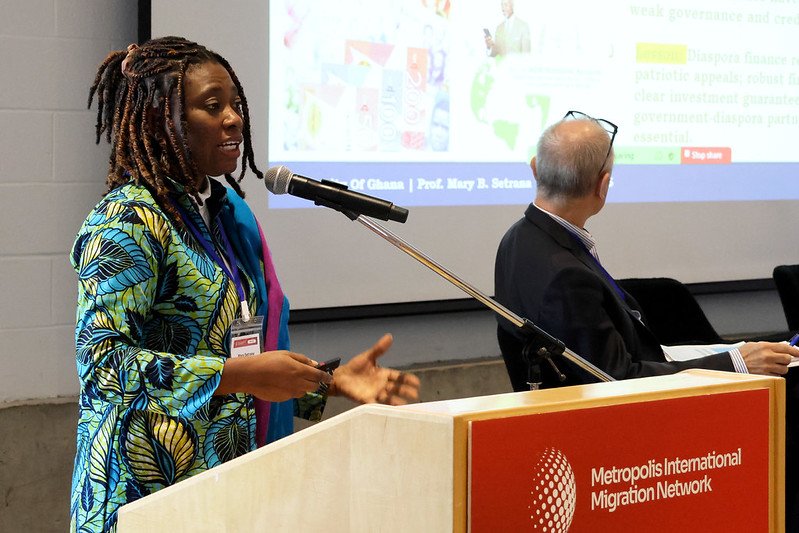
Prof. Mary Boatemaa Setrana pictured at the 2025 Metropolis International Summit in Toronto, Canada.
“Migration has always had a positive impact,” Professor Mary Boatemaa Setrana shares her optimism—not as a slogan, but as a position held in optimism, shaped by lived experience and what she continues to see from those whose lives are, at times, in flux and stretched across borders.
In Kumasi, Ghana, movement is not exceptional, but a normal part of life. It is expected––people leave and people return, measuring time through absence and imagining futures elsewhere while remaining deeply tied to the land. Setrana’s work emerges from this world within African mobility.
Being first encouraged by her father to pursue law in Accra, Mary eventually chose sociology, with a minor in linguistics, and eventually turned toward questions less concerned with institutions and more attentive to lived experience—how people move, how they speak, and how attachment to place persists even across distance.
“Migration is something we negotiate together.”
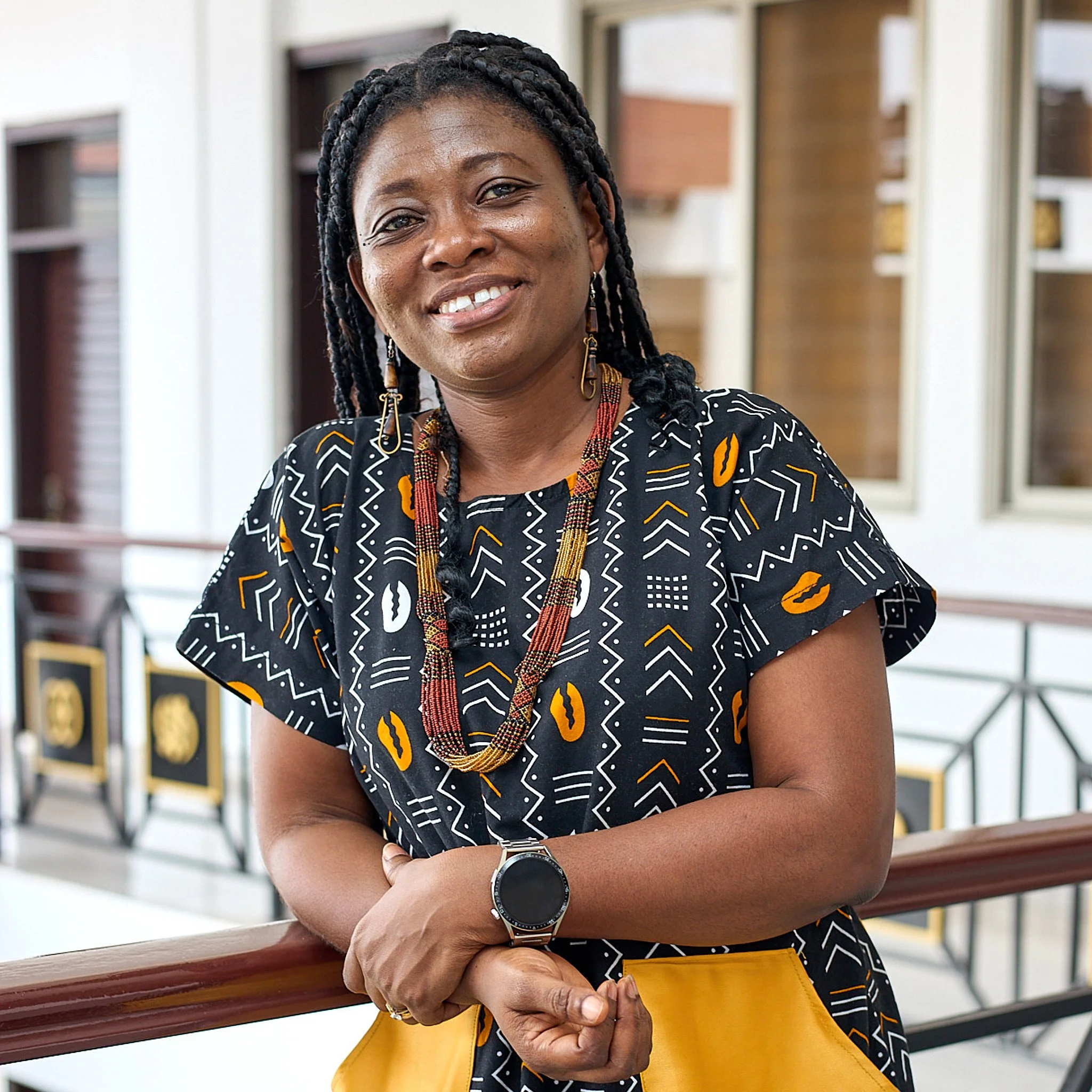
Prof. Mary Boatemaa Setrana.
Later, at the University of Ghana, during her national service in the Department of Sociology, a focus sharpened and migration studies took shape, revealing the visible architecture and latent fissures of social life, most often defined by patterns of mobility, language, and belonging that structure how communities relate to land and to one another. Migration is not a line from one place to another; it is a web of families investing, expecting, interpreting, and recalibrating their position, status, and connection to Ghana. It was, as she puts it, when she began to “understand her people.”
Then, in 2009, she was awarded a prestigious scholarship to study in Norway, designed to build capacity and awareness and ultimately return that knowledge to Ghana.
Distance can illuminate differences. While abroad in Norway, requests came from Kumasi for phones, goods, and small tangible proofs of a life assumed to be more abundant. This was not unreasonable and not surprising. Setrana explains, “Migration carries with it an image of prosperity and access, and more importantly, transformation.” She goes further: “to spend time in the diaspora is to become, in some sense, a resource to those at home.” And return complicates that image.
Those who return to Ghana are expected to carry more than the luggage they left with—knowledge, status, and possibility. In her words, they are meant to “return with a better life,” and to extend it outward, to improve what surrounds them. Yet the conditions they encounter are not always commensurate with what they have learned and seen elsewhere. By comparison, returnees see schools under strain, hospitals stretched, policy frameworks uneven, infrastructure inconsistent, and social systems, at times, unable to absorb transformation.
The “migration gap” does not announce itself loudly. But it accumulates. Setrana teaches, “If one is suffering, we are suffering together.”
The statement reframes the premise. Migration is neither an individual success story nor an individual failure. It is shared across families, expectations, and time. Migrants move under different pressures shaped by gender, profession, income, and status, each contouring experience in distinct ways. To flatten these differences, she argues, is to diminish both policy and understanding. Going further, she resists the familiar pattern in which men appear as neutral migrants and women as exceptions, recognizing instead that both move, both carry expectations, and both renegotiate what provision, care, and responsibility come to mean.
“If one is suffering, we are suffering together.”
As a result, Setrana names three essential stages for migration governance: funding, implementation, and monitoring and evaluation. All three stages are uniquely difficult, but the first is a monumental hurdle she has set as a top priority, because “The one who owns it has the power.”
Funding shapes direction. Direction shapes outcomes. External donors bring resources, but also frameworks, metrics, and priorities. The risk is not their presence, but displacement—local knowledge is often pushed aside by imported structures that read well on paper but function less successfully on the ground.
What follows is a subtle misalignment. Policies function—technically—yet they miss—socially. For too long, Setrana argues, African mobility has been interpreted through lenses not its own. Donors often prioritize risk, containment, crisis, terrorism, and irregular flows, framing migration primarily as a threat detaching displacement from its longer histories of labor, family obligation, and livelihood, while its developmental possibilities and social relationships recede. Setrana’s work presses against that narrowing.
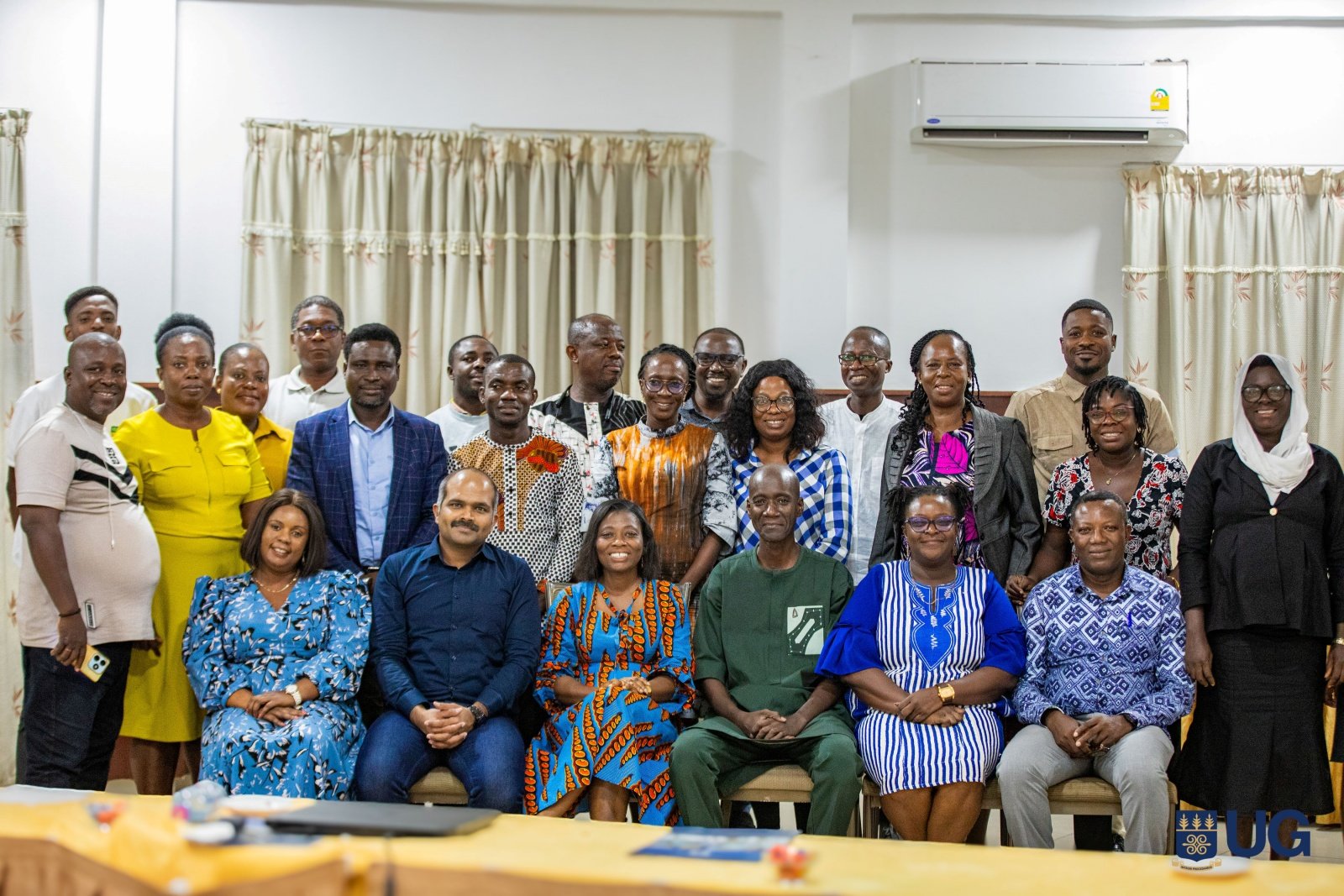
Prof. Mary Boatemaa Setrana (centre, seated) pictured with emerging migration scholars.
These questions, and the triumphs of migration, will come to the fore at the 2026 Metropolis International Migration Network Conference in Accra, where Professor Setrana will host; she hopes the shift toward rethinking African mobility becomes explicit, that past lessons alongside present realities might open space for unprescribed futures. The challenge is not to reject global dialogue, but to rebalance it: to place African scholarship, data, and lived experience at the core of how migration is understood.
She asks those working within these realities to speak for themselves—a “boots on the ground” approach–– “because they know how to define the needs.” From there, response can be shaped, moving beyond being studied toward setting the terms of study.
“Migration,” she teaches, “is something we negotiate together.”
Her insistence extends into questions of citizenship and belonging—who has access to land, to resources, and to the conditions necessary to sustain African livelihoods. These categories suggest clarity for study and applicable. Yet, as Setrana reminds us, lived experience unsettles academic and philanthropic certainty.
From Fulani farmers and herdsmen, whose ties to land are forged through marriage, religion, education, and daily work, to professionals and government leaders in Accra seeking to balance representation, development, and voice, African mobility connects lives that might otherwise appear distinct, accumulating over time a social weight worthy of sustained inquiry and attention. Setrana’s work remains within that negotiation—neither resolving it nor simplifying it, but tracing the relationships that hold it together.
Written by Jen Mabray | PhD Candidate | Brandeis University | Schusterman Fellow
LATEST NEWS